Become the Man Nothing Throws Off.
UNSHAKEN.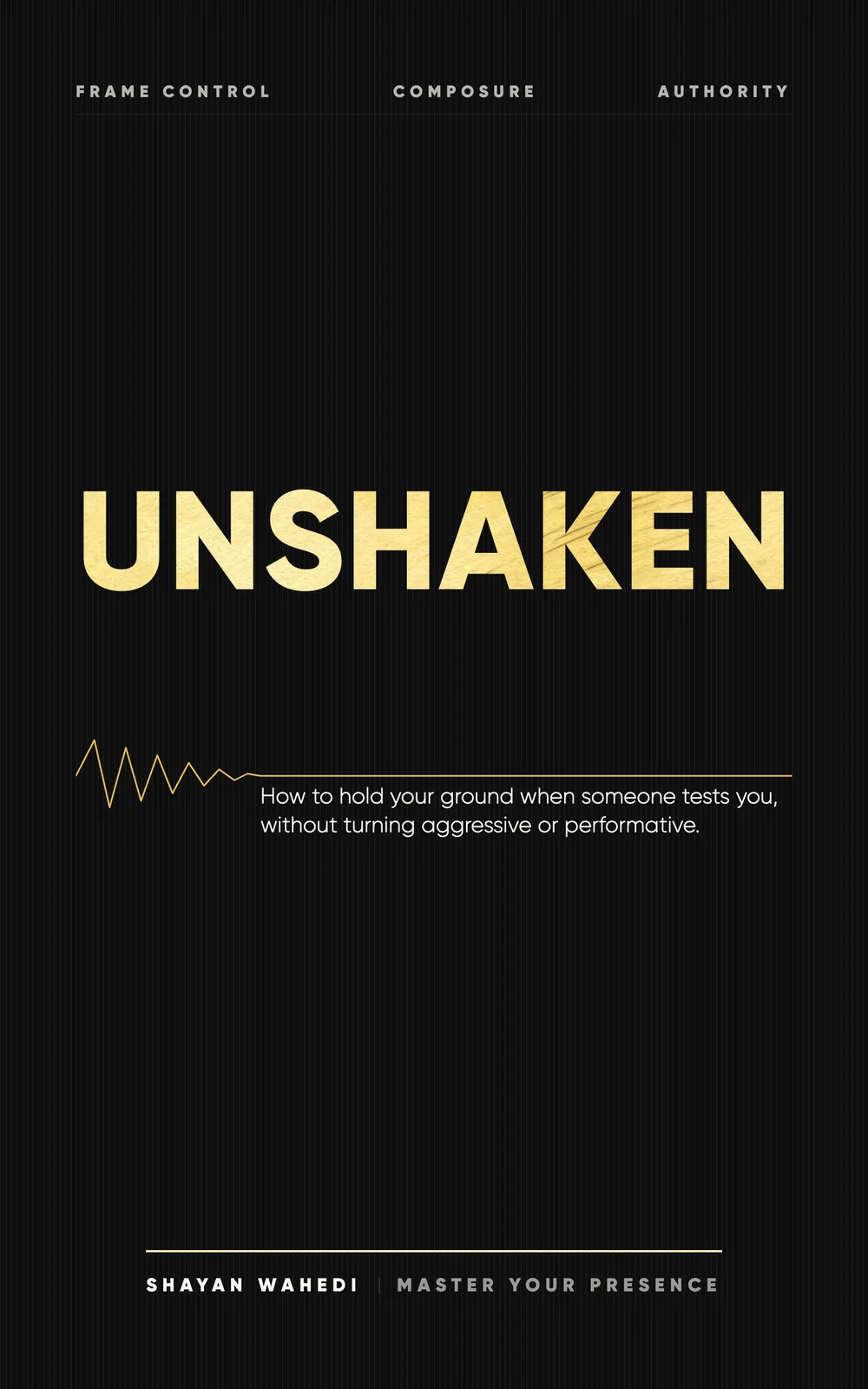
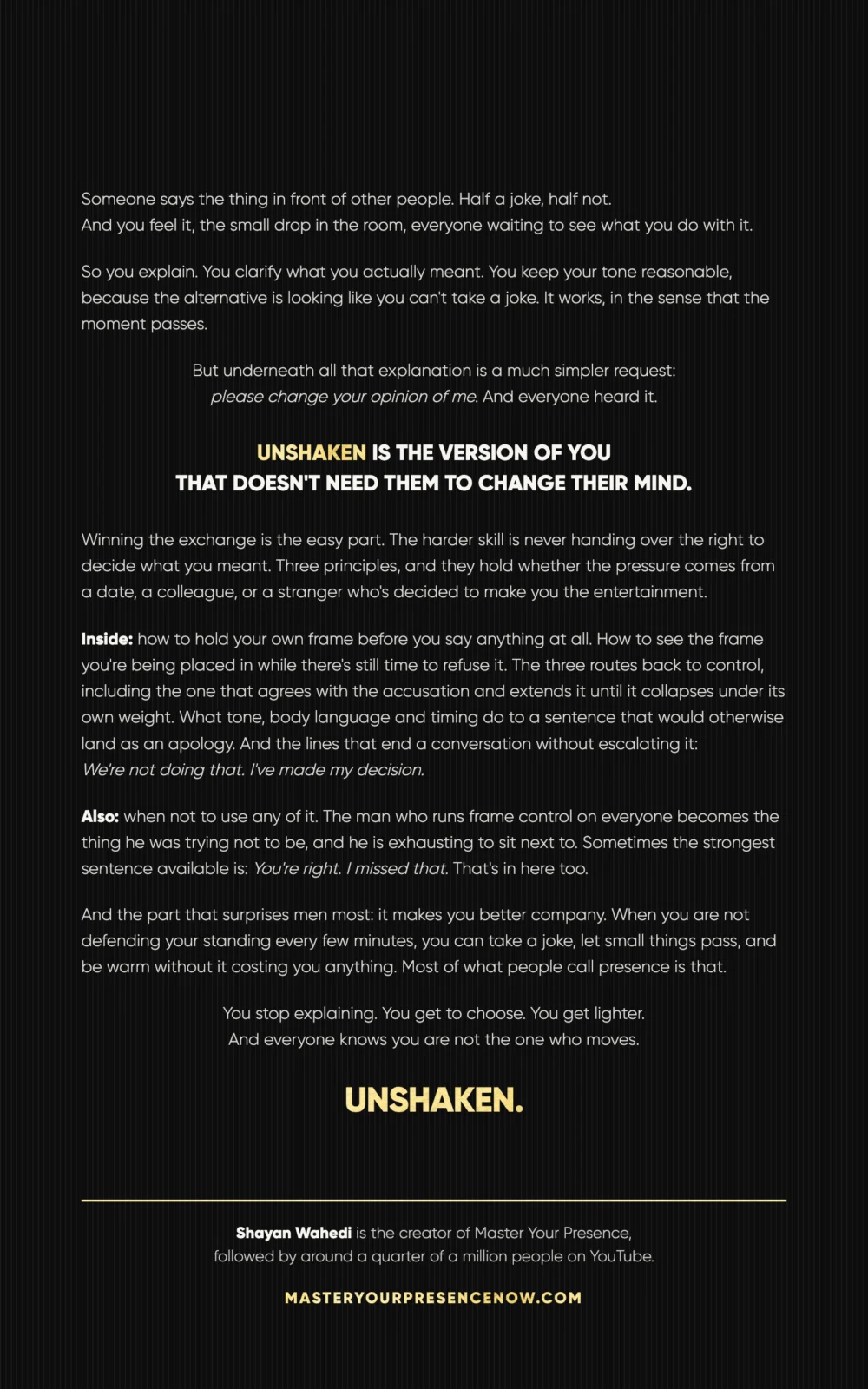
A 62-page ebook that teaches you a solid system for frame control. Nothing lands, nothing rattles you, and somehow you're still the one smiling. That's not a personality trait. It's a drill, and this book runs you through it.
Three principles, drilled until responses just come to you. Yes, there are lines in it, borrow them at first. Eventually you won't need them, you'll just be the man who's naturally quick.
Free 10-page sample
Join my weekly newsletter and get ten pages from UNSHAKEN, Volume I as a welcome gift: why you freeze when someone tests you, the mechanism behind it, one worked example and three drills to try.
You Don't Need More Ideas. You Need
Practice.You have watched the videos. You understood them. Then someone says the thing at dinner, with the little smile, and you hear yourself explaining. Two hours later you know exactly what you should have said, and exactly how you should have said it.
That is not a failure of understanding. Knowing something and being able to produce it while your heart rate is up are two different skills, and only one of them can be taught by watching.
A video gives you one idea at a time, in the order I happened to film it, with nothing to practise against. This book gives you something to practise against.
Reading it takes an evening. Drilling it is what changes you.
This is for the men who are done collecting ideas and ready to change how they carry themselves.
Every principle is built to be used, not admired.
It opens with the mechanism, so you understand why the thing happens to you instead of just being told to stop doing it. Then you watch it unfold in full, with real dialogue and the exact moment the exchange turns.
You see each one go wrong, line by line. Then you see the same scene handled.
After that come the responses. Several for every situation, so you walk away able to build your own instead of carrying a script you have to remember under pressure.
Then the drills. Recognition drills put a frame in front of you and make you commit to an answer before you turn the page. Delivery drills fix the words and change only the tone, so you hear how far the meaning moves without a single syllable being altered.
By the end you are not recalling a chapter. You are reading the room and answering in it.
Three Chapters. Three Skills. In the Order They Have to Be Learned.
Every chapter works the same way. A short explanation of the principle, then the exercises. The explanation is there to make the drills make sense. The drills are what actually move you.
Internal Frame Control
How to hold your own frame before you say anything at all. Where composure actually comes from, why it cannot be faked from the outside in, and what quietly erodes it before a conversation even starts. Then the exercises that build it. By the end of this chapter you stop walking into rooms already negotiating. Nothing in the later chapters works without this one.
Recognition and the Three Routes
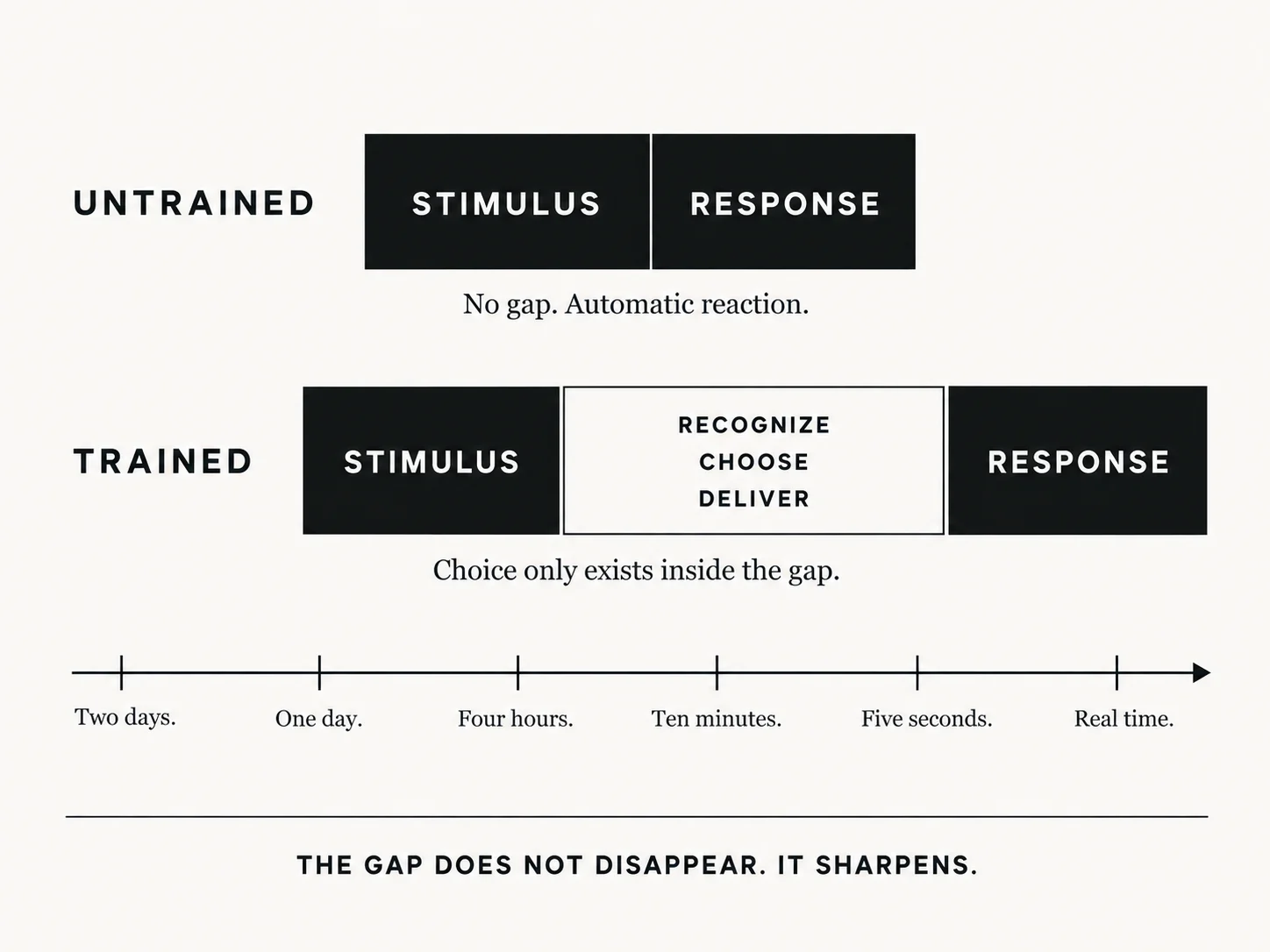
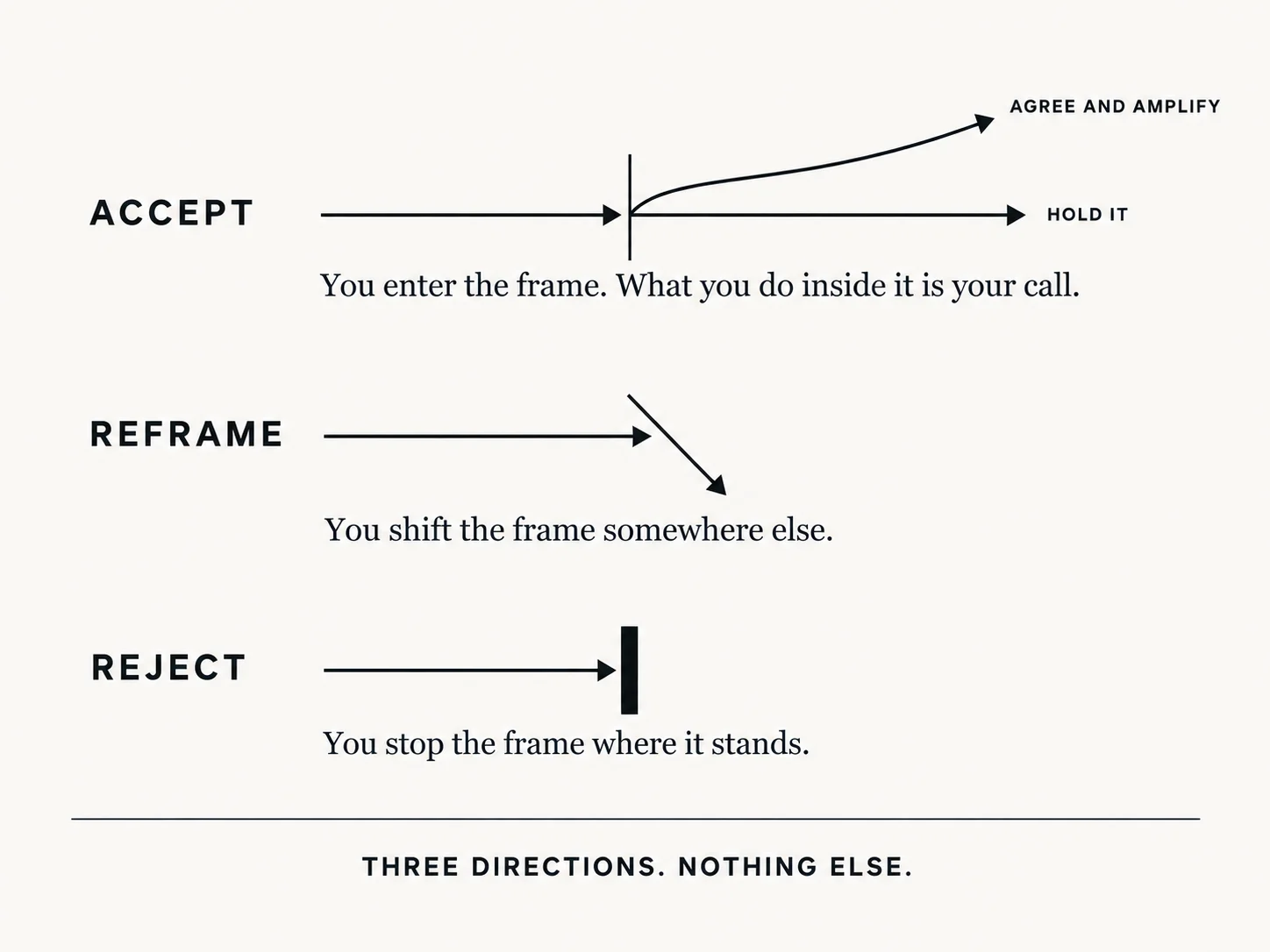
Every social move is an attempt to set a frame. This chapter gives you the sequence: recognise the frame you are being placed in, choose your direction, deliver it with authority. Three routes back to control, accept, reframe, reject. Including the one that agrees with the accusation and extends it until it collapses under its own weight. Worked examples run through romantic, social, and work situations, because the same move looks different in each, and recognition drills so you can practise spotting it before it is happening to you. You stop being surprised by moves you have now seen a hundred times on paper.
Voice, Body, Timing
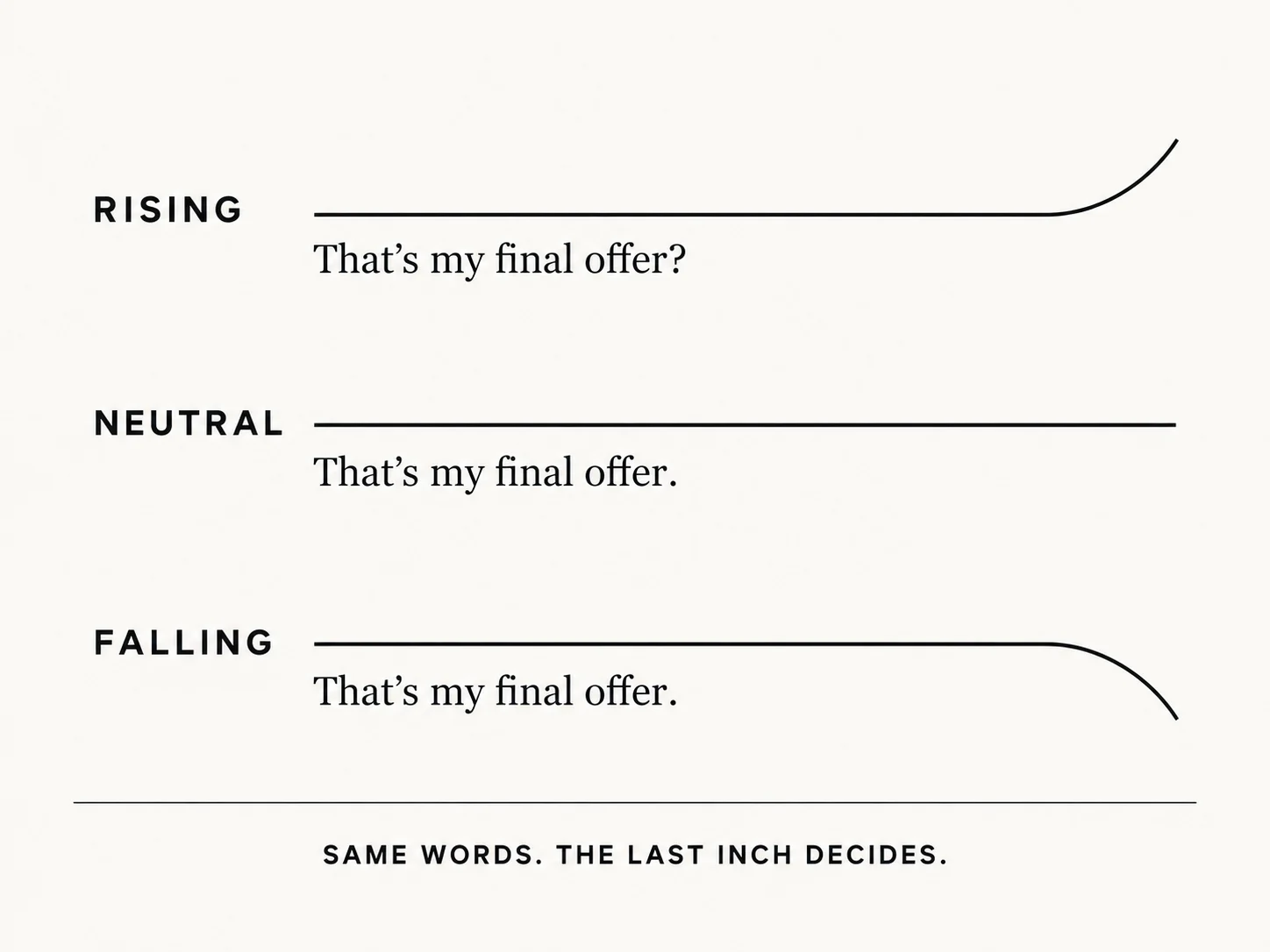
The variables that decide whether a sentence lands as authority or as an apology. Pitch. Volume. Pace. Where you pause. Fidgeting, shifting weight, the hands, the eyes, the half second before you answer. The signal you send is not the signal you intend, and under pressure the gap widens. Delivery drills run through each variable one at a time until you can feel the difference. The test running through this chapter is one question: did I choose that signal, or did it choose me?
One Move. Three Different Outcomes.
Frame control is not only defensive, or offensive.
"You're late again."
"I like to give people something to look forward to."
"I completely messed that up."
"Good. Now you know exactly what to fix."
"You never listen to me!"
"I'm listening now. You've got my full attention. Go again, and show me what I'm missing."
The mechanism is identical in all three. You refuse to treat the first interpretation as the only interpretation available. One shift creates humor. Another creates perspective. The third takes the heat out of something already burning, and it costs you nothing, because you chose it.
Which is why this is worth learning even if nobody is testing you.
Not Every Conversation Is a Frame Battle. Some Are.
Most tests do not need answering. Someone is tired, or clumsy, or making conversation badly. Treat that as a challenge and you become the man who is fighting everyone, which is its own kind of weakness.
But some of it is a frame battle, and pretending otherwise does not make you gracious. It makes you the one who moves, and not because you chose to. You get shaken. Nothing comes. No defense, no offense, completely at the mercy of the frame you were handed and of the person who handed it to you.
Moving because you had no other option is weakness. The exact same move, chosen, is strength. The difference is not the move. It is whether you had anything else available.
This book arms you and widens what you can choose from. It teaches you to tell the difference, and then to win the ones that need winning: cleanly, with or without heat, and without ever looking like you were trying.
About the author
Shayan Wahedi is the creator of Master Your Presence, followed by around a quarter of a million people on YouTube, where he takes scenes from film, television and real life and breaks down what is actually happening in them, moment by moment: body language, vocal tonality, power dynamics, and why the same sentence lands as authority from one person and as an apology from another.
Born in Afghanistan, raised in the Netherlands. He started studying body language and social intelligence whilst studying dentistry at university, not for material, but because he needed it. He has a background in applied psychology and a master's in dentistry, which he still practises alongside the channel.
What Men Wrote Back"I've watched Shayan for years so I knew most of the ideas already. The difference was being made to actually practise them. It's harder than it sounds, sitting down and drilling something instead of just nodding along to a video, but the growth came fast once I did. The biggest change is that I stopped needing to look like the one running the conversation. I sell for a living and I used to push. Now I let him feel like he's leading and I just stay aware of where the frame is."
Charles, 34, sales agent"I was part of the pre-release group, and what surprised me was how quickly I started noticing these patterns in real conversations. Debating has become so much easier. I explain myself far less now. I'm calmer under pressure, and much more deliberate about what I respond to and what I simply let pass."
Gerrit, 22, law student"I read the book as part of the pre-release group. Before this, I always felt like I had to be the one in control. If I wasn't, it felt like the other person was. But once I learned how to stay calm and answer people the way I actually wanted to, that feeling kind of went away. I don't feel like I have to prove myself all the time anymore. I'm a lot calmer, I understand people better, and people around me have even said I'm much more fun to be around now. I feel free."
Kabir, 40, ITGet
UNSHAKENAn hour with me costs $200, and we spend it on your frame. The conversation you lost last week, what he set, what you did, and what you should have done instead. This book is the system underneath that hour, on paper, drillable at three in the morning without an appointment. Most men need this before they need me.
What you getRead It. If It Does Nothing For You, Ask For Your Money Back.
14 days. One email, no explanation required, no forms. I would rather refund a man who got nothing from it than keep his money.
Why buy this when your videos are free?
Because watching is not the same as having it. The videos give you ideas. This gives you the system, step by step, with the exercises that drill it in. You practise it until you are not recalling anything, you are just responding.
Does it give me actual lines to use?
Yes. There are lines in here, and they work. But they are the output of the system, not the system itself. The book teaches you to generate your own, then gives you working examples so you can see what "correct" looks like while you are learning.
Is this for introverts or extroverts?
Both. Nothing in the book requires you to be louder or quicker, and nothing in it requires you to hold back either. It is about holding a position, which is available to any temperament.
How long does it take to learn the system?
You can read and understand it in a day. Internalising it depends on you, how often you run the drills and how willing you are to practise on small moments before the big ones arrive. There is no version of this where you read it once and are changed. The exercises are the product.
What if it does not help me?
Email refunds@masteryourpresencenow.com within 14 days and I will refund you.
A Year From Now
There will be a conversation this month that decides how someone treats you for the next two years. You will not know it is that conversation while it is happening. You never do.
The only thing you control is which version of you is in the room when it arrives.
You stop explaining. You stop needing them to agree. And the room decides you are not the one who moves.
Free sample
Ten pages from Volume I, free
Join my weekly newsletter and get the free sample as a welcome gift: the introduction, the mechanism, one worked example and three drills. Roughly a sixth of the book.